Why MX, SPF, and DMARC Inspection Belongs in Every B2B Outbound Workflow
Before importing a prospect domain into an outbound campaign—or before sending your first cold email from a new secondary domain—three DNS records determine whether messages can be routed and trusted: Mail Exchange (MX), Sender Policy Framework (SPF), and Domain-based Message Authentication, Reporting, and Conformance (DMARC). Checking these records takes less than a second over Cloudflare DNS-over-HTTPS and eliminates entire categories of preventable hard bounces before you spend a single verification credit.
1. Mail Exchange (MX) Records & Gateway Fingerprinting
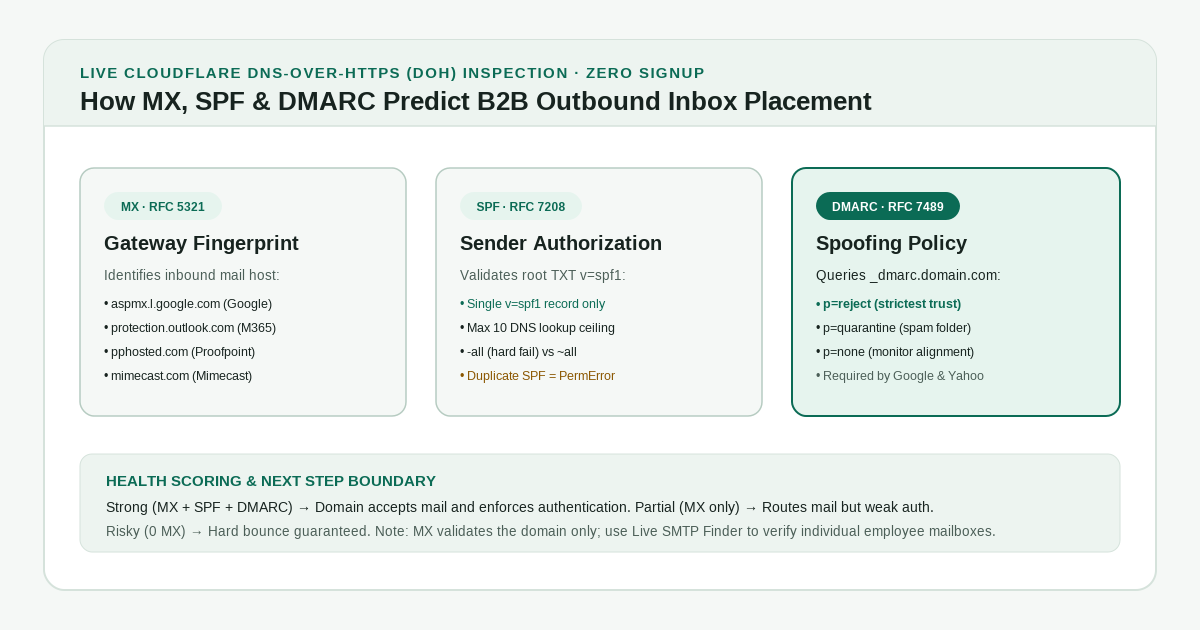
Defined in the core SMTP transport standard, MX records instruct sending mail transfer agents which destination servers accept incoming mail for a domain and in what priority order. If a prospect’s company domain publishes zero MX records—a common occurrence after startup shutdowns, domain migrations, or acquisitions—every email sent to that domain will trigger an immediate SMTP hard bounce. Beyond binary reachability, MX hostnames expose the target organization’s security perimeter so outbound teams can tailor formatting and sending cadence appropriately.
2. SPF Alignment & Outbound Sender Health
SPF records live as root TXT records starting with v=spf1 and list every IP address, cloud workspace, and transactional relay authorized to transmit mail on behalf of your domain. Running this inspector on your own sending domains verifies that exactly one SPF record exists—publishing two separate v=spf1 strings invalidates both with an immediate PermError—and helps you spot bloated third-party includes before they breach the strict 10-DNS-lookup ceiling.
3. DMARC Enforcement (p=none vs p=quarantine vs p=reject)
DMARC builds on SPF and DKIM by publishing an explicit domain-owner policy at _dmarc.yourdomain.com. Since Google Workspace and Yahoo tightened sender requirements, outbound domains lacking a valid DMARC record experience severe spam-folder placement. Publishing at least v=DMARC1; p=none; alongside aligned SPF and DKIM signatures is the minimum baseline for outbound domains, while mature enterprises such as Stripe and Shopify enforce p=reject to block unauthorized spoofing outright.
How Different Enterprise Mail Gateways Treat Cold Outreach
Not all corporate inboxes evaluate incoming B2B messages with the same heuristics. Fingerprinting a prospect’s MX host before launching a sequence gives your revenue team actionable deliverability intelligence:
| Mail Gateway | Typical MX Host Pattern | Key Outbound Deliverability Behavior |
|---|---|---|
| Google Workspace | aspmx.l.google.com | Rewards clean plain-text messages, strict SPF/DKIM/DMARC alignment, and spam complaint rates below 0.3%. |
| Microsoft 365 | *.mail.protection.outlook.com | Sensitive to tracking pixels, newly registered domains, and high-frequency identical templates across a single tenant. |
| Proofpoint | *.pphosted.com | Rewrites links via URL Defense and frequently runs catch-all or tarpit policies; keep first touches link-free. |
| Mimecast | *.mimecast.com | Aggressive greylisting and attachment detonation; avoid PDF attachments and open-tracking pixels on cold touches. |
Common SPF & DMARC Misconfigurations That Quietly Kill Reply Rates
- Exceeding the 10-lookup SPF limit: Nesting multiple marketing, CRM, and ticketing
include:directives pushes DNS resolution past 10 lookups, causing receiving gateways to return a permanent error and ignore your authorization list. - Duplicate root SPF records: Adding a second
v=spf1TXT entry instead of merging mechanisms into one record breaks SPF evaluation across all receivers. - Missing DMARC alignment on secondary sending domains: Teams spinning up lookalike domains for outbound often configure MX and SPF but forget
_dmarc, triggering immediate quarantine on strict corporate gateways. - Assuming valid MX equals valid employee mailbox: Even a domain with strong MX, SPF, and DMARC records rejects mail sent to former employees or misspelled prefixes. Always follow DNS auditing with live SMTP mailbox verification.